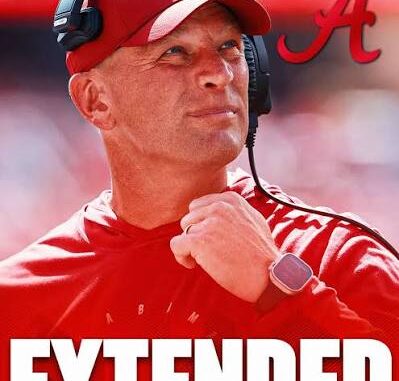
Breaking News: Alabama Has Decided To Extend Kalen DeBoer’s Contract Due To…
TUSCALOOSA, Ala. — Alabama has made its boldest statement yet about the post-Nick Saban era: Kalen DeBoer is the guy, and the Crimson Tide are willing to pay top-five money to prove it.
The University of Alabama System Board of Trustees Compensation Committee formally approved a contract extension for DeBoer on Wednesday, locking him in through January 31, 2033, and raising his annual salary to $12.5 million—a $2 million bump from what he was scheduled to make in 2026 . The seven-year deal, which adds two years to his original contract, makes DeBoer one of the five highest-paid coaches in college football, trailing only Curt Cignetti, Kirby Smart, and Lane Kiffin, and tied with Ohio State’s Ryan Day .
But the decision was not merely about money. It was about stability, survival, and a quiet but unmistakable message to the rest of the SEC.
The Michigan Threat and the Cost of Continuity
The immediate catalyst for the extension was external interest. DeBoer’s name surfaced prominently in Michigan’s coaching search following the dismissal of Sherrone Moore, and sources indicated the Wolverines viewed DeBoer as a legitimate target . With Alabama preparing for a College Football Playoff run, the timing was precarious. DeBoer ultimately stayed, and Michigan hired Utah’s Kyle Whittingham, but the episode exposed a vulnerability Alabama’s administration could not ignore.
“If Alabama wanted to keep him, they needed to do what they needed to do to keep him,” former coach Nick Saban said publicly, offering his rare endorsement of the deal . Saban, who knows something about outside interest, understood the calculus.
The buyout structure reflects Alabama’s determination to prevent another courtship. If DeBoer leaves before January 2027, he owes $10 million. That figure drops to $8 million in 2028 and $6 million in 2029 before vanishing entirely . On the other side, if Alabama fires DeBoer without cause, it owes him 90% of his remaining contract with no offset—a figure that would exceed $67 million if a separation occurred in 2026 . The message is symmetrical: neither party is going anywhere soon.
The Stability Doctrine
Athletic Director Greg Byrne has been unequivocal about the rationale. In an era of unprecedented volatility—transfer portals, NIL collectives, conference realignment—Alabama chose continuity over chaos.
“Kalen DeBoer taking over a historic transition,” Byrne said on “The Triple Option” show. “You know what Coach Saban means to our university, and we are forever grateful to him. And at the same time, too, we knew at some point he was going to retire. And when we looked at that and saw as the world was changing… Kalen was, I really felt had the demeanor, had the coaching chops and history to come and navigate this world” .
Byrne was even more pointed at SEC spring meetings, calling the idea of changing coaches every two to three years “absolutely ludicrous” . The extension, he said, “showed our commitment and belief in him, and we really value stability at Alabama” .
The numbers behind that belief are not overwhelming, but they are not damning either. DeBoer is 20-8 in two seasons, 12-4 in SEC play. He led Alabama to the SEC Championship Game in 2025, a College Football Playoff berth, and a first-round CFP victory over Oklahoma—the program’s first playoff win of the new era . He has eight wins against AP Top 25 teams in two years .
But the lows have been jarring. A 38-3 Rose Bowl demolition at the hands of Indiana. A loss to Georgia in the SEC title game. Regular-season upsets to Vanderbilt, Oklahoma, and Florida State . For a fanbase conditioned by Saban to expect perfection, the variance has been uncomfortable.
The Recruiting Calculus
What the extension does, perhaps more than anything, is stabilize the foundation DeBoer is building on the trail. Alabama has secured consecutive top-five recruiting classes under DeBoer, and the 2026 season will be the first in which the Crimson Tide will start a quarterback DeBoer personally recruited . Continuity at the top is a selling point that rival coaches cannot match.
The timing also matters for the roster. In the portal era, a lame-duck coach is a liability. A coach with a contract running through 2033 is a promise. For current players weighing whether to stay, and for prospects weighing whether to come, the extension answers the only question that matters: Is DeBoer going to be here?
The Saban Seal of Approval
Perhaps the most significant validation came from the man whose shadow DeBoer inhabits. Saban, who retired after the 2023 season and watched a significant portion of the roster depart in the aftermath, acknowledged the difficulty of the handoff.
“I think when I retired, I think 26 players moved, which was hard for the next coach, whoever it was, to overcome,” Saban said. “And I think they’ve done a pretty good job of making that transition” .
Saban’s endorsement does not guarantee success, but it removes a potential source of internal friction. The most powerful voice in Alabama football history is not whispering against the current coach. He is publicly supporting him.
What Comes Next
The extension does not eliminate pressure. It amplifies it. DeBoer now has the security and the salary of an elite coach, and the expectations at Alabama remain unchanged. A national championship is the standard, not a aspiration.
The 2026 season will be the first true referendum on DeBoer’s program. The quarterback battle between Austin Mack and Keelon Russell will define the offense. The defensive front must prove it can hold up against the Georgias and Indianas of the world. And the fanbase, scarred by the Rose Bowl and energized by the CFP win, will be watching with the impatience that only Tuscaloosa can produce.
But for now, the message from the administration is clear. Alabama did not hire Kalen DeBoer to be a bridge. They hired him to be the coach. And they have just proven it with the most concrete commitment a university can make.
The DeBoer era is no longer an experiment. It is the plan.
Leave a Reply