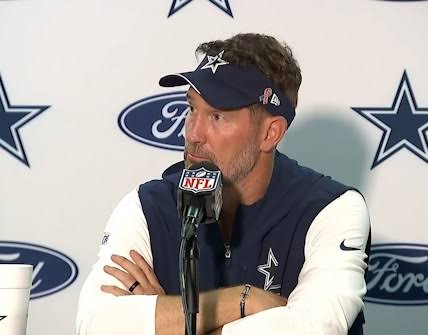
UPDATE: Brian Schottenheimer Explains Why Dallas Cowboys’ Offense Lacks Creativity
FRISCO, Texas — The Dallas Cowboys’ 2026 season was supposed to be defined by a rebuilt defense and a high-powered offense capable of outscoring opponents. Instead, through six weeks, the offense has become the primary source of frustration, and head coach Brian Schottenheimer is now offering his explanation for why a unit featuring Dak Prescott, CeeDee Lamb, and George Pickens has looked remarkably stagnant.
Following a 23-13 loss to the Green Bay Packers on Sunday night—a game in which Dallas was shut out in the first half for the first time since 2021—Schottenheimer addressed the growing criticism regarding the predictability of his play-calling. His explanation, however, pointed the finger back at the defense and the game script it has forced upon the offense.
The Motion Problem and Playing From Behind
The most glaring statistical regression for Dallas has been the near disappearance of pre-snap motion. In 2025, Schottenheimer’s offense ranked 13th in the NFL in motion rate at 56.6%. In 2026, that number has plummeted to a league-worst 36.5% .
Critics, including former players and analysts, have argued that the lack of motion makes the offense “one-note” and easy for defenses to read. Schottenheimer’s response was pragmatic rather than schematic.
“You’re trying to go fast. You’re trying to keep the defense on their heels. You’re trying to extend the game for as long as you can and get as many ops as possible, because you don’t know what’s going to happen,” Schottenheimer said via the Dallas Morning News . “So that’s the No. 1 thing. When you shift in motion, obviously the play clock and the game clock go down, and so that limits your ops.”
Essentially, Schottenheimer argues that because the Cowboys’ defense has struggled to get off the field and the team has been playing from behind, the offense has been forced into a hurry-up, no-huddle approach. In that mode, shifting receivers and using complex motions becomes a luxury the team cannot afford, as it slows down the pace and reduces the total number of plays available to mount a comeback .
The Numbers Behind the Stagnation
While Schottenheimer’s explanation has a degree of football logic, the underlying numbers suggest the problems run deeper than just pace. The Cowboys have scored just 29 combined points in their last two games—losses to the previously winless Tampa Bay Buccaneers and the Packers .
The offense has become remarkably one-dimensional. Dallas is running the ball at the lowest rate in the league (32.5%), and the rushing attack is averaging just 76.0 yards per game, second-worst in the NFL . Without a credible run threat, opposing defenses have been able to tee off on Prescott.
The results have been stark. Over the last two weeks, Prescott has thrown for 335 yards, one touchdown, and four interceptions, posting a passer rating of 66.9 . The explosive plays that defined the “Greatest Offense There Is” moniker have vanished. Against Green Bay, Dallas managed just one play of 20 yards or more, and that came after the two-minute warning .
Internal Frustration and External Criticism
The frustration is mounting from all corners. Offensive coordinator Klayton Adams admitted last week that the unit is still “searching for an identity” and used a boxing analogy to describe the imbalance.
“We need to be able to hit you with both hands, and we’re kind of competing with one arm tied behind our back right now because we really haven’t been very good in the run game,” Adams said .
Schottenheimer echoed that sentiment after the Packers loss, acknowledging that the lack of a running game has made the offense “a little bit one-sided” . However, his decision to abandon the run early against Green Bay—calling 55 pass plays compared to just 15 rushing attempts—drew scrutiny, especially with the game remaining relatively close until the fourth quarter .
Former Cowboys legend Dez Bryant voiced the concerns of many fans, specifically targeting the underutilization of George Pickens, who received zero targets in the first quarter and just one in the first half against Green Bay . “Pickens is a deep threat who thrives on contested passes,” Bryant noted. “Right now, Dallas is doing its opponents a favor by taking him out of the game” .
Even former players who played under Schottenheimer have weighed in. Braylon Edwards, who played for Schottenheimer with the New York Jets, took to social media to call his former coordinator a “mid OC” and pointed to the Cowboys’ recent struggles as confirmation of his limitations .
What Comes Next?
The Cowboys sit at 2-4, tied for their worst start to a season this decade. In the Super Bowl era, Dallas has never made the playoffs after starting 2-4 . With a Monday night matchup against the Philadelphia Eagles looming, the pressure on Schottenheimer is intensifying.
The coach maintains that the fix is execution, not necessarily creativity. “We have a great process. We practice the right way. We’re just not executing what we need to win games,” Schottenheimer said . But as the losses mount and the offense continues to sputter, the explanation for the lack of creativity—blaming the defense and the scoreboard—may not be enough to quiet the growing chorus of doubters in Dallas.
For a team that entered the season with Super Bowl aspirations, the reality of a last-place motion rate and a last-place run rate is a harsh awakening. The creativity isn’t just missing; according to Schottenheimer, the circumstances haven’t allowed it to exist.
Leave a Reply