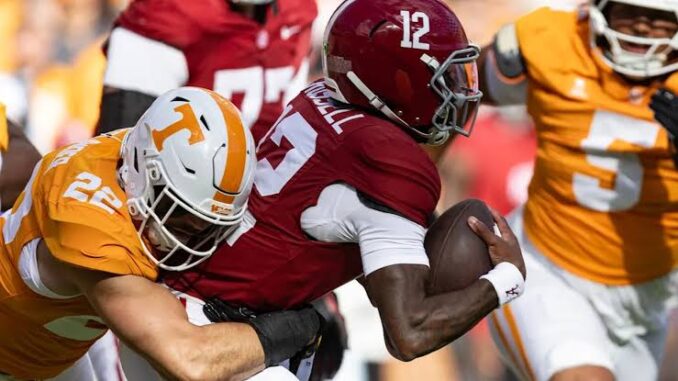
Why Alabama Is Still Rated Highly by Computer Models After Bad Loss to Tennessee
TUSCALOOSA, Ala. — By almost any eye test, Alabama’s 26-10 loss to Tennessee on Saturday was a disaster. The Crimson Tide managed just 201 total yards, committed four turnovers, and were thoroughly outplayed in the trenches at Neyland Stadium . It was the program’s first back-to-back regular-season losses since 2007, and it dropped Alabama to 5-2 with a gauntlet still ahead.
Yet when the computer models updated Sunday morning, Alabama barely budged.
ESPN’s Football Power Index (FPI) dropped the Crimson Tide just one spot, from No. 5 to No. 6 nationally . Jeff Sagarin’s model also has Alabama at No. 6. Brian Fremeau’s FEI model moved Alabama from No. 3 to No. 4—a single-position slide after a performance that looked far worse than that . Even Bill Connelly’s SP+, which was harsher, only dropped Alabama to No. 12 .
The disconnect between what happened on the field and what the algorithms see is jarring. But it is not accidental. The models are telling us something specific about how they evaluate teams—and why Alabama’s résumé still carries weight despite the ugly tape.
The Models Are Measuring Something Different
The first thing to understand is that FPI, FEI, and SP+ are not polls. They do not rank teams by wins and losses, nor by how impressive a team looked in its most recent game. They are predictive systems designed to answer a different question: how good is this team, really, and how will it perform going forward?
That distinction matters enormously for Alabama. The models are built on underlying efficiency metrics—success rates, explosiveness, field position, opponent adjustments—that are far more stable week to week than raw scores. One bad offensive outing against a strong Tennessee defense does not erase five weeks of highly efficient football.
More importantly, the models are looking at who Alabama has played. And that is where the Crimson Tide’s case becomes surprisingly strong.
The Schedule Argument
Fremeau’s FEI model rates Alabama’s schedule as the toughest in college football. Specifically, Fremeau breaks strength of schedule into three separate measurements, and Alabama ranks No. 1 in two of them and No. 2 in the third .
This is not a minor detail. When a computer model evaluates a team, it must account for the quality of opposition. A 201-yard performance against Tennessee—a defense that just held Alabama to its second-lowest yardage total since 2016—is not the same as a 201-yard performance against a middling Group of Five opponent . The models adjust accordingly.
Alabama’s two losses have come against Georgia and Tennessee, both of which remain highly rated in the models. Tennessee’s win moved the Volunteers up only one spot to No. 12 in FPI, which tells you the algorithm already respected what Tennessee was capable of . Losing to good teams, even badly, does not crater a predictive rating the way losing to bad teams does.
The FPI also notes that Alabama has played the third-hardest schedule to date, but its remaining schedule ranks just 35th . The models are, in a sense, projecting that Alabama’s performance will improve simply because the opposition will get easier.
The Playoff Probability Collapse
Here is where the models do agree that Alabama is in serious trouble.
While Alabama’s FPI ranking barely moved, its College Football Playoff probability plummeted. Before the Tennessee game, ESPN’s FPI gave the Crimson Tide an 82.4% chance of reaching the playoff. After the loss, that number fell to 49.4%—a staggering 33-percentage-point drop in a single week .
That collapse reflects the harsh math of a 12-team playoff. No team with three regular-season losses has made the field in the two-year history of the expanded format. Alabama already has two losses. With four SEC games remaining—including a trip to LSU and the Iron Bowl—the margin for error is effectively gone .
The models are saying two things simultaneously: Alabama is still one of the most talented and efficient teams in the country, and Alabama is now one loss away from playing itself out of the bracket. Those statements are not contradictory. They are the difference between measuring quality and projecting outcomes.
The Eye Test Problem
The computer models have a blind spot, and everyone who watched Saturday’s game knows what it is.
Alabama’s offense has now been shut out in the second half of back-to-back games. Quarterback Keelon Russell, once a Heisman contender, looked uncomfortable and indecisive against Tennessee’s pressure, completing 19 of 29 passes for 147 yards with two interceptions . The running game offered no relief. The offensive line allowed consistent penetration. For the second consecutive week, the Crimson Tide failed to score a second-half point .
The FEI can measure efficiency. It cannot measure the look in a quarterback’s eyes when the pocket collapses. It cannot measure the cumulative psychological toll of consecutive losses to rivals in a program that has known almost nothing but championship expectations for two decades.
That is why the College Football Playoff selection committee exists. The committee watches the games. It sees the 201 yards. It sees the four turnovers. It sees a team that, in the words of offensive tackle Jackson Lloyd, “hasn’t been ourselves” for two straight weeks . When the committee releases its first rankings on November 3, it will not care that FPI has Alabama at No. 6. It will care that Alabama looked broken against Tennessee.
What the Models Are Really Saying
The computer models are not saying Alabama is fine. They are saying Alabama is good, and that its body of work—weighted for opponent strength and adjusted for efficiency—still profiles as one of the nation’s better teams.
But “good” is not the standard at Alabama. “Good” does not win championships, and it does not guarantee a playoff berth in a 12-team field stacked with SEC contenders. The models can keep Alabama at No. 6 in their rankings while simultaneously telling you its playoff hopes are a coin flip. Both are true. And both, in their own way, are damning.
Alabama has five games left to prove the models right and the eye test wrong. The first comes Saturday against Texas A&M at Bryant-Denny Stadium. Win out, and the FPI’s 99% playoff probability in that scenario becomes reality . Lose again, and the algorithms will finally be forced to agree with what everyone saw in Knoxville.
The machines are patient. The committee will not be.
Leave a Reply