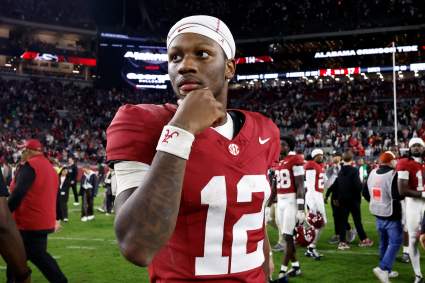
Alabama’s Keelon Russell Reveals Fourth-Quarter Message After Admitting Early Frustration
TUSCALOOSA, Ala. — The box score will show that Keelon Russell threw for 311 yards and three touchdowns in No. 13 Alabama’s 31-20 victory over Texas A&M on Saturday. It will show that he completed 19 of 30 passes and engineered a fourth-quarter surge that turned a three-point deficit into a two-score win, ending a two-game skid for the Crimson Tide .
What the box score will not show is the internal battle Russell fought before he ever delivered that fourth-quarter message.
After the game, Alabama’s sophomore quarterback stood at the podium and did something that is becoming increasingly rare in college football: he admitted he had been part of the problem. Russell acknowledged that the first half had tested him personally, that he had returned to the sideline with his head down, and that he had failed to take accountability for the things going wrong around him .
“Stuff wasn’t going right for us in the first half. Particularly me, stuff wasn’t going right for me,” Russell said. “I wanted to blame myself because I had my head down a lot. Not taking accountability for a lot of things” .
That honesty is what makes his fourth-quarter message carry weight. Leadership does not require pretending frustration never happens. It requires recognizing when that frustration becomes unproductive, accepting help, and returning to the next possession with something better to offer .
The Message: Poise, Trust, and a Push to Win
When asked what he told the offense at the start of the fourth quarter, Russell did not offer a complicated schematic adjustment or a fiery motivational speech. The message was direct.
“We just got to go win,” Russell said. “We got to play our game, be poised. When things don’t go right, don’t throw your head down” .
That is a straightforward directive, but it matters coming from the quarterback. Teammates look toward that position when possessions become difficult and pressure builds. Russell was asking Alabama to remain focused on what it could still accomplish rather than dwelling on what had already happened.
The Crimson Tide entered the fourth quarter trailing 20-17. Russell had thrown an interception earlier in the game, a play where he scrambled, pointed to Rico Scott in a curl route, and threw a missile that was intercepted by Texas A&M’s Dezz Ricks. He laid on the ground afterward, his head in the turf .
That was the moment Russell needed help. And according to him, it came from the locker room.
“They showed a lot of love to me,” Russell said of his teammates. “They were able to just pick me back up and keep me going” .
From Frustration to Execution
The turnaround was immediate. On the first play of the fourth quarter, Russell found Marshall Pritchett for a touchdown to give Alabama the lead for good . After a Texas A&M three-and-out and a shanked punt, Russell led a drive that ended with an 8-yard touchdown pass to Kalen Edwards, creating the final cushion .
Russell completed each of his last seven pass attempts for 105 yards and two touchdowns. His No. 1 target was Rico Scott, who finished with six receptions for 156 yards .
“We got confidence, and we need him to continue to do that,” Alabama coach Kalen DeBoer said of his quarterback. “That’s why he’s out there for us” .
The performance was a stark contrast to the previous two weeks. Against Georgia and Tennessee, Russell admitted the game sped up on him. He shouldered the blame for making the game harder than it had to be, for not taking the easy and simple plays . Alabama had lost two straight for the first time since 2013, and the offense had been shut out in the second half against the Volunteers .
Against Texas A&M, the first half looked like more of the same. Russell was frustrated, and his body language showed it. But the second half told a different story.
“He kind of just takes on the challenge every week,” Scott said. “He plays the hardest position on the field, so just to see him be resilient helps the team because I feel like if he’s off mentally, then we’re all going to be off” .
Accountability as a Leadership Tool
Russell’s willingness to publicly identify his own reaction as a problem is notable for a player in his first full season as a starter. He did not blame the offensive line, the receivers, or the play calling. He said his head was down, and he said he was not taking accountability .
That kind of admission becomes more credible when it includes something specific. Russell did not offer a vague “I need to be better” statement. He identified behavior he did not like and said so publicly .
He also made sure to credit the teammates who helped him recover. The exchange is revealing: Russell needed encouragement before he could deliver it himself. For Alabama, having teammates willing to provide that support matters just as much as having a quarterback willing to acknowledge he needed it .
“It’s understanding that I have to be perfect on my end so that the play can get positive yards and not negative yards,” Russell said .
That perfection is not attainable, of course. But the standard is the point. Russell is learning that leadership at Alabama does not require never struggling. It requires what he did against Texas A&M: admit the struggle, accept the help, deliver the message, and then go execute.
The message at the start of the fourth quarter, it turned out, was one Russell needed to hear himself before he could give it to anyone else.
Leave a Reply