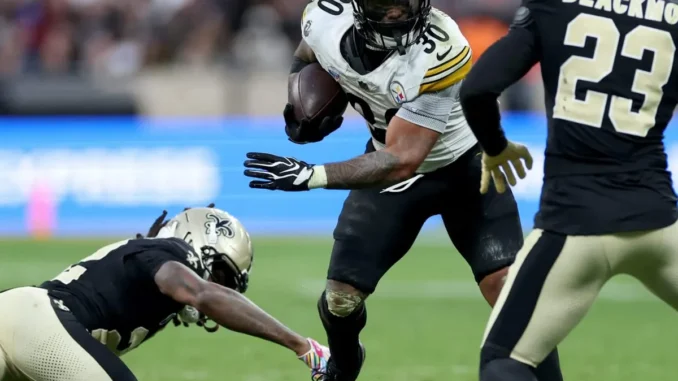
REVEALED: Steelers Cracked the Code Against the Saints with Old-School Football Tactics
PARIS — The NFL’s first regular-season game in France was supposed to be a showcase for the modern game: spread formations, quick passes, and the international debut of a future Hall of Fame quarterback. Instead, Mike McCarthy turned back the clock.
Pittsburgh’s 16-10 victory over New Orleans at Stade de France on Sunday was a masterclass in vintage football—a throwback blueprint built on a dominant running game, a suffocating run defense, and just enough heroics from a 42-year-old quarterback when the moment demanded it . The Steelers (5-2) didn’t just beat the Saints (2-5); they physically imposed their will on a team that had no answer for old-school football.
The Blueprint: Run the Ball, Own the Clock
The numbers tell the story of a game plan executed to near perfection. Pittsburgh rushed for 148 yards on 30 carries, a 4.9-yard average, while holding New Orleans to a staggering 18 rushing yards on 17 attempts—a 1.1-yard average that ranked as the second-fewest rushing yards allowed in an NFL game this season .
“We felt as a football team that we needed to own the line of scrimmage on both sides,” McCarthy said afterward. “We felt going through the game plan process that was gonna be an important factor in the game, and we definitely hit the target there” .
The approach was deliberate. The Saints entered the game with the league’s 30th-ranked run defense, and Pittsburgh exploited that weakness relentlessly . Jaylen Warren, the Steelers’ do-it-all back, rushed for 101 yards on 18 carries—his third 100-yard game in five weeks—and added three catches for 36 yards . Rico Dowdle complemented him with 41 rushing yards and 45 receiving yards, giving Pittsburgh a two-headed backfield that kept New Orleans off balance all afternoon .
What made the performance truly old-school was the method. Pittsburgh ran only seven offensive drives the entire game, but four of them lasted 11 plays or more . The Steelers held the ball for over 32 minutes, methodically draining the clock and keeping Tyler Shough and the Saints’ offense stranded on the sideline. It was a strategy straight out of a bygone era: shorten the game, limit possessions, and trust your defense to make the one or two plays that decide the outcome.
The Jumbo Package Returns
Perhaps the most revealing tactical wrinkle was McCarthy’s decision to dust off the “jumbo package”—a formation featuring offensive lineman Spencer Anderson lined up as a tackle-eligible extra tight end . The look was so retro it felt like a relic from a 2025 game film, but it worked.
On the very first snap with Anderson as an eligible receiver, Warren ripped off a 29-yard run . The Steelers averaged 9.6 yards per carry on their opening drive, marching down the field before settling for a Chris Boswell field goal . The message was sent immediately: Pittsburgh was going to run the ball, and New Orleans was powerless to stop it.
“Spence is a really good player, so it’s fun to be able to get him on the field,” guard Mason McCormick said. “He does a really good job at it” .
The commitment to the ground game represented a philosophical shift for a Steelers team that had been pass-happy through the first six weeks. Against the Saints, McCarthy clearly decided that Rodgers’ arm wasn’t the weapon—it was the threat of Rodgers handing the ball off that would break New Orleans.
Rodgers Plays the Perfect Supporting Role
Aaron Rodgers’ final stat line—19 of 30 for 212 yards, one touchdown, no interceptions—won’t remind anyone of his MVP seasons . But that was precisely the point. Rodgers wasn’t asked to win the game with his arm; he was asked to manage it.
The defining moment of Rodgers’ afternoon wasn’t a touchdown pass. It was an 8-yard scramble on third down late in the fourth quarter that sealed the victory . With the Saints needing one stop to get the ball back, Rodgers pulled down the ball and ran for the first down, allowing Pittsburgh to kneel out the clock. It was the kind of play that defined his early career in Green Bay, and for one afternoon in Paris, it was enough.
Rodgers did connect on one signature throw: a 51-yard bomb to DK Metcalf that set up Pittsburgh’s only touchdown, a 4-yard fade to the 6-foot-7 Darnell Washington, who boxed out a helpless Kool-Aid McKinstry for the score . It was the lone explosive play in an otherwise grinding offensive performance, and it proved decisive.
“We knew coming in, we could run against them,” Rodgers said. “I felt like we controlled the line of scrimmage with Jaylen and Rico” .
The Defense Delivers the Knockout
For all the talk of old-school offense, the game turned on a play that embodied the other pillar of vintage football: opportunistic defense.
Midway through the third quarter, the Saints had driven 68 yards in 14 plays, eating 7:28 off the clock, and were knocking on the door at Pittsburgh’s 10-yard line . A touchdown would have given New Orleans its first lead of the game. Instead, Tyler Shough telegraphed an out route, and linebacker Payton Wilson dove in front of Chris Olave for an interception at the 11-yard line .
“That was the play of the game,” said inside linebacker Patrick Queen, who finished with a game-high 10 tackles and a crucial fourth-quarter sack . The Saints never threatened again.
The defensive performance was a team effort. T.J. Watt, Alex Highsmith, and the edge rushers generated consistent pressure on Shough, even if the sack numbers (two) don’t reflect it . The run defense was historically dominant, holding Alvin Kamara to 5 yards on six carries and the entire Saints backfield to 18 yards . New Orleans became one-dimensional, and Pittsburgh’s secondary—led by Wilson and Jamel Dean—made the plays when it mattered.
The Bigger Picture
The victory moved Pittsburgh to 5-2 and into at least a share of the AFC North lead, with a critical rematch against Cleveland looming . For a team that entered the season with questions about offensive identity and defensive consistency, the Paris game offered a template: when the passing game sputters, lean on the run; when the opponent threatens, trust the defense to deliver.
For New Orleans, the loss dropped the Saints to 2-5 and deepened the scrutiny on coach Kellen Moore and GM Mickey Loomis, who received an ultimatum from owner Gayle Benson earlier this month . Shough threw for 278 yards and a touchdown, but his red-zone interception and a missed field goal by Daniel Carlson doomed the Saints in a game they controlled for long stretches .
As the Steelers boarded their flight home with the first NFL victory in French soil secured, the takeaway was unmistakable. In an era of spread offenses and passing records, Pittsburgh proved that old-school football—run the ball, stop the run, and make the one play that matters—still works. Especially when the opponent has no answer for it.
“We wanted to use our strengths against their weaknesses,” Warren said . On Sunday in Paris, that simple formula was all the Steelers needed.
Leave a Reply