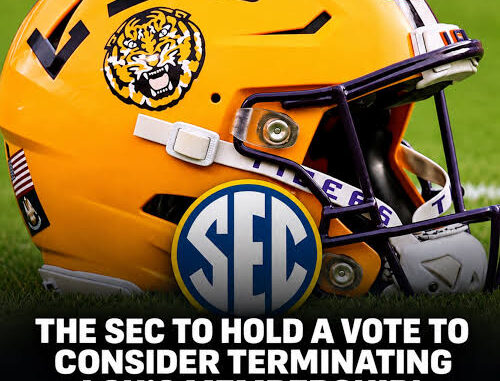
BREAKING: SEC Sets December 3 Vote on Terminating LSU Membership Over “Brazen” Defiance
BATON ROUGE, La. — The Southeastern Conference has formally scheduled a special meeting of its presidents and chancellors for December 3 to decide whether to terminate LSU’s membership in the conference, escalating a months-long legal and governance war into an existential threat against one of the SEC’s founding members.
The bombshell development, revealed Monday in a federal court filing in Birmingham, Alabama, marks the second time this year the SEC has threatened expulsion—but this time, the conference’s language leaves little room for doubt that a vote is imminent.
The Condition: Playing a Former Pro
The immediate trigger for the December 3 meeting is LSU’s decision to roster and play guard RJ Luis Jr., a 23-year-old who previously signed a two-way NBA contract with the Utah Jazz and spent time with the Boston Celtics organization. The SEC adopted emergency legislation in August barring member institutions from rostering athletes who had signed professional contracts or declared for professional drafts. The penalty structure adopted unanimously—with LSU abstaining—included a half-season suspension for the offending coach, a fine equivalent to 50% of the sport’s annual operating budget, and revocation of voting privileges.
Luis was added to LSU’s roster on November 17. The following night, he scored 11 points and grabbed nine rebounds in 15 minutes during the Tigers’ 79-67 victory over Louisiana-Monroe. The SEC alleges LSU officials made “numerous representations” before that game that Luis would not play.
“The presidents and chancellors of the other fifteen members of the SEC deferred addressing and making a decision about LSU’s membership in light of LSU’s assurances,” the SEC’s amended complaint states. “It has become apparent that these assurances were hollow promises”.
“Brazen Violation” and “Deficient Institutional Control”
In its filing, the SEC accused LSU of a “brazen violation” of conference professionalism rules, “deficient institutional control” over its athletics programs, and a “lack of respect for and blatant disregard for the core tenets and principles of the SEC”. SEC Commissioner Greg Sankey stated in an affidavit that he was told on multiple occasions—including in an October phone call with LSU basketball coach Will Wade—that Luis would not play for the Tigers.
LSU President Wade Rousse issued a statement last week saying he had instructed Wade not to play Luis moving forward, and Luis was subsequently removed from the online roster. But the SEC’s filing asserts that the conference will consider expulsion “regardless of whether LSU continues not to play Mr. Luis,” arguing that “the SEC simply cannot be certain that Defendants won’t change their minds and violate longstanding Conference rules again”.
The conference’s legal position has been complicated by a Louisiana state court injunction that prevents the SEC from imposing its adopted penalties on LSU for playing Luis. The SEC acknowledged in its filing that it has “no avenue to penalize” LSU through the normal enforcement mechanism—leaving termination of membership as the remaining recourse under conference bylaws.
The Math and the Stakes
Under SEC rules, termination of membership requires a vote of at least two-thirds of the conference’s presidents and chancellors. With 16 member institutions, that means 11 votes would be needed to expel LSU. Multiple reports indicate that the votes may already exist. Yahoo Sports’ Ross Dellenger reported that some LSU sources believe the threshold has been reached, and ESPN’s Paul Finebaum stated this week that “the votes are there”.
Former LSU football coach Brian Kelly, now an analyst for CBS Sports, told SiriusXM on Tuesday that he would “be surprised if they don’t vote LSU out”.
“They’ve asked them to come and meet them halfway a couple of times,” Kelly said. “I think the (RJ) Luis situation and playing him in the game went against any kind of good faith that they had”.
A Founding Member on the Brink
LSU has been a member of the SEC since the conference’s founding in 1932. Expelling the Tigers would be an unprecedented act in major college athletics—and one that would carry enormous financial and competitive consequences for both sides. LSU is one of the SEC’s most recognizable brands, with a football program that has won multiple national championships and a fan base that ranks among the most passionate in the sport.
The dispute has deep roots. In September, the SEC filed a federal lawsuit against LSU after football coach Lane Kiffin attempted to roster two former NFL players—tight end Dae’Quan Wright and defensive lineman Zxavian Harris—who had signed professional contracts. Kiffin ultimately backed down, and a scheduled expulsion vote was never held. The SEC’s lawsuit, however, was never dropped, and the conference has argued that LSU’s conduct with Luis represents a pattern of defiance rather than an isolated incident.
The SEC is also seeking a temporary restraining order to prevent LSU or Louisiana Attorney General Elizabeth Murrill—a named defendant—from interfering with the December 3 meeting or the conference’s exercise of its governance authority.
What Comes Next
LSU has not publicly responded to the latest filing. The university’s options appear narrow: it can attempt to negotiate a last-minute resolution with the conference, as it did in September, or it can prepare for a vote that could end a 94-year relationship with the conference it helped build.
The December 3 meeting was originally scheduled for routine SEC business but has been repurposed specifically to address LSU’s membership status. For a university and a conference that have been synonymous with college football’s highest level for nearly a century, the meeting represents a rupture few could have imagined—and one that will reshape the landscape of the sport regardless of the outcome.
Leave a Reply