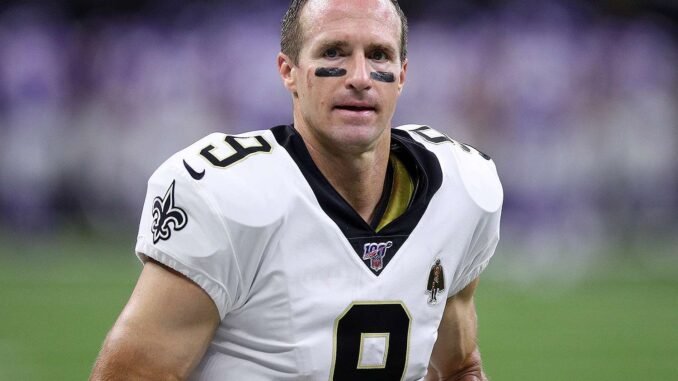
80,358 Passing Yards. 571 Touchdowns. 1 Super Bowl Ring.
The Hall of Fame conversation surrounding Drew Brees is once again gaining momentum, and this time, the tone feels less like debate and more like recognition of an undeniable legacy.
For years, Brees has stood at the center of discussions about greatness — not because of a lack of production, but because of how his career has been framed in comparison to other legendary quarterbacks of his era.
Now, as the football world reflects on one of the most prolific passers in history, many are revisiting not just the numbers, but the impact.
Brees retired as one of the most statistically accomplished quarterbacks the NFL has ever seen. His 80,000+ passing yards and 571 touchdowns once placed him at the very top of the league’s all-time rankings, while his accuracy redefined what efficiency at the quarterback position could look like. Yet, for a long time, critics attempted to attach qualifiers to his success — labeling him a “system quarterback” within the offensive scheme of Sean Payton.
But those who followed his journey closely understand that narrative never told the full story.
When Brees signed with the New Orleans Saints in 2006, both player and franchise were at a crossroads. Brees was coming off a serious shoulder injury that had cast doubt over his future, while the Saints were still reeling from the devastation of Hurricane Katrina. What followed was not just a turnaround — it was one of the most remarkable rebuilds in professional sports.
From his very first season in New Orleans, Brees brought stability, leadership, and belief. Under his direction, the Saints quickly transformed into one of the most dangerous offenses in the league. His ability to read defenses, deliver precise throws, and elevate the performance of those around him became the foundation of the team’s identity.
That transformation reached its peak during the 2009 season.
In Super Bowl XLIV, Brees delivered one of the most composed and efficient performances in championship history, leading the Saints to a victory over the Indianapolis Colts. He was named Super Bowl MVP, completing a journey that had once seemed uncertain and cementing his place in NFL history.
Still, the debates persisted.
In an era defined by quarterbacks with multiple championships, Brees’ single Super Bowl victory was often used as a point of comparison. However, analysts and former players alike have increasingly pushed back on that narrow view, pointing instead to his consistency, durability, and the sheer volume of elite-level production over nearly two decades.
Beyond the statistics, Brees’ influence extended into the culture of the Saints organization and the city of New Orleans itself. Teammates frequently described him as a relentless competitor and meticulous leader, while fans embraced him as a symbol of resilience during a period of recovery and renewal for the city.
His legacy is also reflected in the evolution of the modern passing game. Brees proved that success at the quarterback position was not limited to size or traditional physical prototypes. Instead, he emphasized timing, intelligence, and accuracy — qualities that have since become central to how the position is evaluated and developed.
As Hall of Fame discussions intensify, the consensus across much of the football community is becoming clearer. Brees’ résumé, when viewed in totality, leaves little room for doubt. His records, his championship, and his impact on and off the field collectively form a career that meets — and arguably exceeds — the standard for enshrinement.
For fans in New Orleans and across the league, the conversation is no longer about whether Drew Brees belongs among the all-time greats.
It’s about fully appreciating just how high he stands among them. 🏈
Leave a Reply