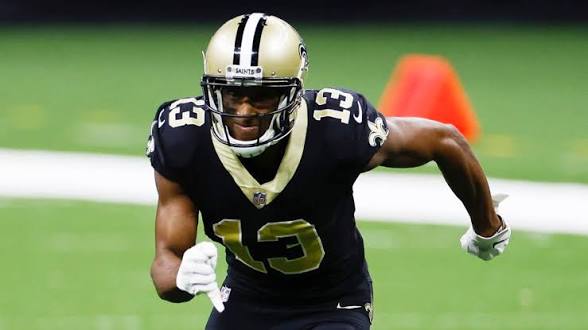
The New Orleans Saints suffered a significant blow to their offense when star wide receiver Michael Thomas was diagnosed with a high-ankle injury that was expected to sideline him for several weeks. The injury occurred during New Orleans’ Week 1 victory over the Tampa Bay Buccaneers in the 2020 season, and what initially appeared to be something Thomas could play through quickly became a much bigger concern.
Thomas entered that season as one of the NFL’s most productive receivers. Coming off a historic 2019 campaign, he had established himself as quarterback Drew Brees’ primary target and one of the league’s premier possession receivers. In 2019, Thomas caught an NFL-record 149 passes for 1,725 yards, earning first-team All-Pro honors and the Associated Press Offensive Player of the Year award.
Because of that production, losing Thomas for multiple games represented a major challenge for the Saints. The team had initially hoped the receiver might be able to manage the injury and return quickly. However, reports from NFL Network indicated that the high-ankle injury was worse than originally believed, making a longer absence necessary.
Thomas’ injury also affected the way defenses could approach New Orleans. His ability to consistently win underneath routes, particularly slants and intermediate passes, had been a major part of the Saints’ offensive identity. Even when he was not making explosive plays, his presence forced defenders to pay attention to him, creating opportunities for other players.
With Thomas unavailable, the Saints had to rely more heavily on other offensive weapons. Emmanuel Sanders, who had joined New Orleans that offseason, became an important option at wide receiver. Tight end Jared Cook and versatile running back Alvin Kamara were also expected to carry more responsibility in the passing game.
The injury was particularly frustrating because Thomas had played every game during each of his previous three seasons. His durability had been one of his defining characteristics, making the sudden absence even more difficult for the Saints to absorb.
Unfortunately, Thomas’ ankle problems ultimately became much more complicated than a short-term absence. He missed significant time during the 2020 season, and the injury eventually required offseason surgery. In 2021, another setback in his recovery kept him out for the entire season.
The original “several weeks” diagnosis therefore became an important turning point in Thomas’ career. At the time, the Saints were simply hoping their star receiver could recover and return to the lineup. Instead, the ankle injury developed into a prolonged problem that affected multiple seasons.
For New Orleans, the immediate priority was protecting Thomas from further damage while finding ways to keep the offense productive. The Saints had enough talent to remain competitive, but replacing a receiver who had just set the NFL’s single-season reception record was never going to be simple.
Thomas’ injury serves as a reminder of how quickly an NFL team’s plans can change. What initially looked like a manageable ankle issue became a major storyline for both Thomas and the Saints, ultimately having consequences far beyond the several weeks o


riginally expected.
Leave a Reply