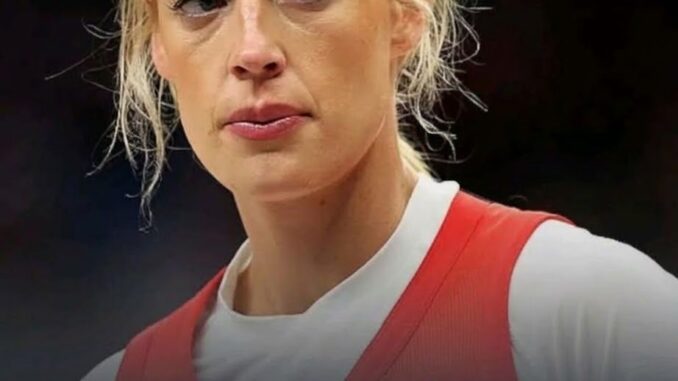
Sophie Cunningham to Depart Indiana Fever After One-Year Contract Expires Due to Several Reasons
INDIANAPOLIS — Sophie Cunningham’s tenure with the Indiana Fever has officially concluded. The veteran guard’s one-year, $665,000 contract expired following the Fever’s first-round playoff elimination at the hands of the Las Vegas Aces, and multiple factors have converged to make her departure from Indiana a near certainty as she enters unrestricted free agency .
Cunningham, who turns 30 in August, leaves Indianapolis after two seasons that were defined as much by her viral moments and outspoken personality as by her efficient three-point shooting. Her exit marks the end of one of the most discussed player-team partnerships in recent WNBA history — a relationship that delivered on-court value but ultimately became entangled in contract frustrations, cultural controversies, and a fundamental misalignment between her aspirations and the franchise’s long-term vision.
Contract Length, Not Money, at the Heart of the Split
The most concrete reason for Cunningham’s departure is the structure of her contract. When she signed a one-year, $665,000 deal before the 2026 season, she made no secret of her frustration — not with the salary, but with the lack of long-term security .
“I just wanted to be somewhere for more than one year,” Cunningham said in April. “I’m almost 30 years old. I want to have a home. I want to get established. And I would love to get established in a place like Indiana” .
Cunningham clarified that she had received multi-year offers from other teams but chose to return to Indiana on a one-year deal because of her relationships with teammates and the team’s championship potential . However, the Fever’s front office prioritized short-term contracts to maintain financial flexibility for future extensions for stars like Caitlin Clark and Aliyah Boston .
That strategic choice left Cunningham in a precarious position: valued enough to retain, but not enough to commit to. After another one-year deal expired without a long-term offer materializing, the writing was on the wall.
Off-Court Controversy Created an Unsustainable Environment
Cunningham’s 2026 season was not merely a basketball story. In July, an ESPN interview thrust her into the center of a national culture war when she said, “I want to protect young girls in a locker room, or young girls in sport who shouldn’t have to go against biological men” .
The comments, widely viewed as transphobic, sparked protests outside Fever games, prompted league-wide responses, and attracted bad-faith actors who sought to exploit the controversy for political purposes . Demonstrations erupted at Gainbridge Fieldhouse, forcing the Fever organization to issue statements and address the situation publicly .
While Fever general manager Amber Cox stated that Cunningham’s off-court comments would “have no bearing” on whether the team attempted to re-sign her, the broader environment became increasingly difficult to manage . As one analysis in The Athletic put it, the Fever “have been reduced to performing in the background while the world’s most contentious Thanksgiving dinner drags on” .
The controversy also strained the locker room dynamics of a team that already faced intense scrutiny due to Clark’s unprecedented fame. Cunningham’s presence, while embraced by some segments of the fanbase, introduced new divisions that the franchise ultimately had to weigh against her on-court contributions.
On-Court Value Was Real, But Not Irreplaceable
From a purely basketball perspective, Cunningham delivered solid production. In 43 regular-season games for the Fever, she averaged 7.9 points on 46.0% shooting, including a career-best 41.9% from three-point range . She was Indiana’s top scorer off the bench, logging 22.2 minutes per contest while providing spacing alongside Clark, Kelsey Mitchell, and Boston .
Her efficiency was undeniable. Basketball-Reference data shows Cunningham posted a 62.0% effective field goal percentage and a 12.6 PER in 2026 . She embraced a 3-and-D role, defended multiple positions, and brought a physical edge that coach Stephanie White described as “contagious” .
Yet the advanced metrics reveal a more complicated picture. The Fever actually performed better offensively when Cunningham was off the court, with an offensive rating of 120.8 compared to 114.3 when she played . Defensively, her 113.7 rating ranked among the bottom 20 qualified players in the league . While her hustle and toughness were valued, her overall impact on winning was marginal — a reality that made committing significant long-term money to a 30-year-old role player difficult to justify.
Cunningham finished the 2026 season without receiving a single first-place vote for Sixth Player of the Year, despite Indiana’s public campaign on her behalf . Golden State’s Janelle Salaün won unanimously.
The Fever’s Future Demands Flexibility
Indiana enters a critical offseason with $3.6 million in cap space and seven players under contract for 2027 . Building a championship contender around Clark requires strategic allocation of resources, and the Fever must decide whether Cunningham’s production justifies a multi-year commitment at a higher salary.
Cox indicated the team plans to engage in conversations with Cunningham’s representatives, but interest from both sides does not guarantee a deal . Cunningham will enter unrestricted free agency in February with the ability to negotiate with any team — and given her shooting ability and veteran experience, she is likely to attract suitors seeking perimeter depth.
For Cunningham, the calculus is equally clear. She has spent eight seasons in the WNBA, six with Phoenix and two with Indiana, and has yet to find a long-term home. Her growing media profile — including a podcast, endorsements, and appearances outside basketball — suggests she is preparing for life after her playing career . At 30, with a major knee injury in her recent past, securing a multi-year deal that provides stability and compensation may be her priority.
A Relationship That Ran Its Course
Cunningham’s departure is not a story of failure. She arrived in Indiana via trade in 2025, rehabbed a torn MCL, and returned to post career-best shooting numbers . She became a fan favorite, a meme icon, and a fierce defender of her teammates — particularly Clark, who called her “the kind of teammate every team would kill to have” .
But the WNBA is a business, and the Fever are building something larger than any single role player. Cunningham’s contract length frustrations, the external chaos she attracted, and her marginal on-court impact relative to her market value all pointed toward separation.
As free agency approaches, Cunningham will seek the security Indiana never offered. The Fever will seek flexibility and a cleaner path forward. Both sides, it seems, are ready to move on.
For Cunningham, the next chapter remains unwritten. For the Fever, the focus shifts to building around Clark — without the turbulence that came with her most vocal protector.
Leave a Reply