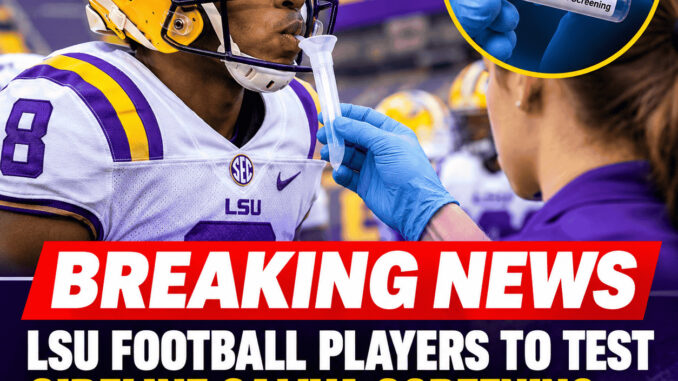
Breaking News: LSU Football Players to Test Sideline Saliva Screening for Concussions
BATON ROUGE, La. — LSU football players will participate in a groundbreaking research study this season that could one day allow athletic trainers to diagnose concussions on the sideline using nothing more than a saliva sample and a rapid test tube, university researchers announced.
The project, led by Dr. Guillaume Spielmann, associate professor in the LSU School of Kinesiology and lead trauma researcher at Our Lady of the Lake, aims to identify specific proteins in saliva that signal brain injury. Throughout the 2026 football season, researchers will collect samples from approximately 40 to 60 LSU football players at regular intervals to establish baseline profiles and track changes over time.
“Concussions and repetitive head impacts remain a significant concern for athletes, yet we still lack practical tools to detect and monitor brain injury early and accurately in real-world settings,” Spielmann said.
The Science Behind the Spit Test
The research builds on years of work by Spielmann and his team, who previously studied blood proteins associated with traumatic brain injury. In an earlier study of more than 40 football players, they found that some blood proteins linked to brain injury increased even when athletes were not concussed and showed no changes in brain structure or function.
That finding prompted a search for more precise biomarkers using saliva, which can be collected easily, frequently, and without needles. Saliva samples are taken via a small cotton swab placed underneath the tongue—a process practical enough for sideline use during games.
“Taking blood is not practical, so what we’ve really wanted to do is identify a way to use a tissue that’s more readily available,” Spielmann explained.
If an athlete sustains a concussion during the season, researchers will collect additional saliva and blood samples. These will be compared against samples from non-concussed players and evaluated alongside established assessments of balance, eye movement, memory, and cognition.
The ultimate goal, Spielmann said, is a rapid diagnostic test that could be administered on the sideline. “My ultimate goal would be, if we find proteins of interest, can we develop a rapid diagnostic test where you’re on the side of the field and, for lack of a better word, spit in a tube?”
Why Saliva Research Matters
Current sideline concussion assessments rely primarily on subjective symptom reporting and cognitive tests such as the SCAT5, which incorporates the Standardized Assessment of Concussion, the Post-Concussion Symptom Scale, and balance testing. While these tools are validated and widely used, they suffer from a critical limitation: athletes often underreport symptoms, and without baseline scores, meaningful changes can be difficult to detect.
The challenge was underscored by a 2021 study published in the British Journal of Sports Medicine, which examined salivary small non-coding RNAs in concussed rugby players. While the study was celebrated in media headlines as evidence that concussions could be diagnosed through saliva, experts cautioned that the diagnostic accuracy was initially modest, with the best-performing biomarker showing an area under the curve of just 0.71—statistically considered a poor test. However, when researchers combined multiple biomarkers and allowed time for expression changes, accuracy improved substantially, reaching an AUC of 0.89 at 36 to 48 hours post-injury.
A larger prospective study of professional rugby players in England subsequently demonstrated that a panel of 14 salivary small non-coding RNAs could differentiate concussed athletes from controls with an AUC of 0.91 immediately after matches and 0.94 at 36 to 48 hours, with prospective validation showing even stronger predictive accuracy.
These findings suggest that while a single biomarker may not be sufficient, a carefully selected panel of molecules could eventually provide the objective data point that sideline assessments currently lack.
Building on LSU’s Research Infrastructure
The concussion study is one of seven research initiatives receiving more than $1.6 million through the Collaboration in Action Program, a competitive grant partnership between Our Lady of the Lake and LSU that supports new approaches to Louisiana’s most pressing health challenges. Spielmann’s project specifically received $238,073 from the program.
The project brings together experts from LSU, Pennington Biomedical Research Center, and Our Lady of the Lake with backgrounds in kinesiology, medicine, sports performance, athletic training, and clinical research. It also connects with LSU’s Institute for the Health and Performance of Champions, which focuses on the health, well-being, and performance of competitive, tactical, and operational athletes.
“Our partnership with Our Lady of the Lake shows what’s possible when world-class researchers focus their talents on the health challenges facing Louisiana,” LSU Chancellor Jim Dalton said in a statement. “As LSU pursues its goal of becoming a Top 50 research university, partnerships like this one are how we’ll get there—by turning discovery into real impact for the people of our state.”
The university’s existing concussion policy already emphasizes baseline testing and research engagement, noting that LSU “remains thoughtfully engaged in research and data collection that has the potential to positively change the way athletics approaches concussions”.
Beyond the Gridiron
While college football provides the initial setting for the study, Spielmann envisions applications extending far beyond the sport. Military personnel exposed to blast overpressure, first responders working in unpredictable environments, and children who suffer traumatic injuries could all benefit from a non-invasive, needle-free diagnostic approach.
“If you are in a field or if you are far away from a place where you can take blood, using saliva is a very easy method to really detect something without having to be invasive,” Spielmann said.
He also emphasized that the research is about more than wins and losses. “It’s really easy to get lost in scores and in touchdowns,” he said, “but they are athletes. They are people. No matter how competitive they are, they need to remain healthy, and we need to help keep them that way.”
Sample collection began in June and will continue throughout the 2026 season. Initial analysis is targeted for June 2027, with results expected to be published within 12 months. Spielmann hopes the findings will provide the foundation for future studies and, eventually, a rapid, non-invasive test that could change how concussions are detected in sports and beyond.
Leave a Reply