KNOXVILLE, Tenn. — The Southeastern Conference is facing its most serious officiating crisis in years, and the fallout from Saturday’s Alabama-Tennessee game may have finally reached a breaking point.
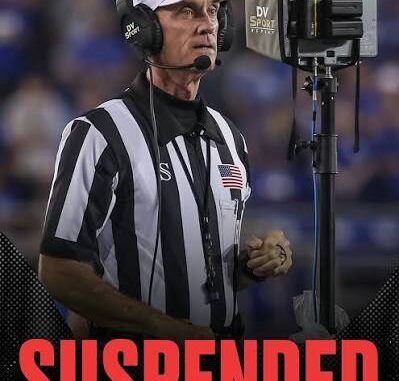
Multiple sources close to the situation have indicated that at least one referee from the crew that worked the No. 6 Crimson Tide’s stunning loss to the No. 14 Volunteers is now facing a suspension. While the SEC has not issued a formal public statement—consistent with its longstanding policy of not commenting on judgment calls—the internal pressure on Commissioner Greg Sankey’s office has reportedly become immense.
The controversy stems from a sequence in the first half that has since gone viral across every corner of college football social media.
The Play That Broke the Dam
With Alabama driving and Tennessee clinging to an early lead, a replay circulated by longtime SEC media personality Chris Marler showed what appeared to be a clear and obvious facemask penalty on a Tennessee defender against Alabama receiver Rico Scott. Instead of the flag going against the Volunteers, Alabama was penalized for a block in the back on the same play.
The reaction was immediate and ferocious.
“It takes a supreme commitment to not just miss a call, but then to fabricate one on top of it,” one fan wrote in response to Marler’s post. Another simply said: “Come on, man”.
The Alabama fanbase, already seething from a controversial no-call the previous week in a heartbreaking loss to Georgia—when officials declined to flag what many believed was obvious pass interference on a deep ball to Rico Scott in the end zone—erupted. The narrative that the Crimson Tide were being unfairly targeted by SEC officiating crews gained undeniable momentum.
For the conference office, this was no longer a localized complaint. It was a full-blown credibility crisis.
The Sankey Dilemma
Commissioner Sankey addressed the Georgia-Alabama controversy earlier in the week with characteristic caution. “We have indicated previously that we don’t comment on judgment calls,” Sankey said at SEC basketball media days. “We have a high level of expectation of performance for everyone involved… Our officials dedicate a great deal of time to preparation, and in those bang, bang moments, there are disagreements”.
That measured tone may no longer be sustainable.
The problem for the SEC is twofold. First, the visual evidence from the Tennessee game—particularly the uncalled facemask that preceded a penalty against Alabama—is difficult to explain away as a mere “bang-bang” moment. It was not a judgment call in the traditional sense; it was a missed call compounded by an incorrect one.
Second, the timing is catastrophic. The SEC has already faced scrutiny this season over officiating consistency, and the Alabama-Georgia game generated enough outrage that Sankey was forced to address it publicly. Now, just days later, another high-profile game involving the same team has produced another viral controversy.
If a suspension is confirmed, it would represent a rare and significant admission of failure by the conference. The SEC has historically protected its officials from public accountability, preferring to handle discipline internally. But in the era of social media, where every frame is dissected in real time, that approach is becoming untenable.
The Human Element
Lost in the furor is the human dimension. Referees are part-time employees who undergo extensive training, yet they are asked to make split-second decisions in front of 100,000 screaming fans and millions more watching at home. The facemask rule, as national coordinator Steve Shaw explained in a rules video, requires a player to grasp and then twist, turn, or pull—a standard that is often impossible to adjudicate in real time.
But that explanation rings hollow for Alabama fans who watched their team’s season slip further away in a hostile road environment.
Alabama’s offensive coordinator Ryan Grubb, to his credit, refused to blame the officials after the Georgia loss. “I know people want to talk about the refs and stuff, and I’m not here to talk about that,” Grubb said. “We had plenty of chances to win the game”. Head coach Kalen DeBoer struck a similar tone, saying the Crimson Tide “can’t put the game in that situation where the officials come into play”.
That stoicism may be admirable, but it does not absolve the conference of its responsibility to ensure fair and competent officiating.
What Comes Next
If the reported suspension is confirmed, it would send a clear message that the SEC is at least attempting to hold its officials accountable. But it would also raise uncomfortable questions about the broader state of officiating in the conference.
Alabama fans are already demanding more: some have called for pass interference to become a reviewable penalty, a change that would require NCAA-wide approval and has been debated for years without resolution. Others want the SEC to publicly grade and release officiating reports, a level of transparency the conference has historically resisted.
For Tennessee, the win is secure and the celebration in Knoxville continues. But the Volunteers’ victory will forever carry an asterisk in the minds of Alabama faithful—fair or not—because of the flags that flew and the flags that did not.
For the SEC, the pressure is only beginning. Sankey’s office must now navigate a path between protecting its officials and restoring public trust in the integrity of its games. The conference that prides itself on “It Just Means More” is learning that in the modern era, accountability means more too.
The SEC has not confirmed the suspension as of press time. This is a developing story.
Leave a Reply