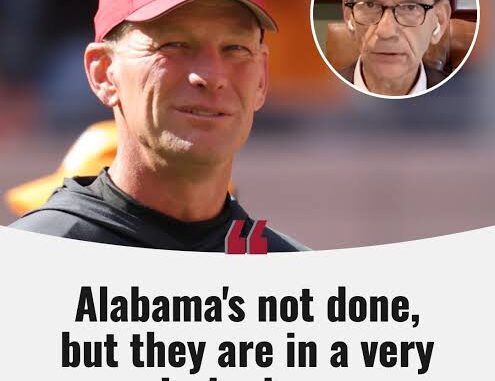
Finebaum: Alabama in a ‘Very Dark Place’ After Tennessee Beatdown
Paul Finebaum didn’t mince words. The ESPN analyst and Alabama fixture used his weekly appearance on The Matt Barrie Show to deliver a blunt assessment of Kalen DeBoer’s program following the Crimson Tide’s 26-10 loss at Tennessee—a defeat that marked Alabama’s first back-to-back regular-season losses since 2007 .
“Alabama’s not done, but they are in a very dark place,” Finebaum said. “I can’t tell you the amount of anger and animus that I heard as that game was coming to an end” .
The core of Finebaum’s critique wasn’t about scheme or talent. It was about a pattern—one that has defined DeBoer’s tenure in Tuscaloosa and has now eroded the goodwill he built during a 5-0 start.
The Pattern That Won’t Break
Finebaum laid out the history with precision. In 2024, DeBoer beat Georgia, then lost to Vanderbilt the following week. Later that same season, after wins over Missouri and LSU revived playoff hopes, Alabama was blown out by a 5-5 Oklahoma team, effectively ending its CFP chances .
This year, the script repeated. Alabama lost a close game to Georgia—a game Finebaum said “felt like a win” to fans because of the competitive performance and officiating controversies that dominated the discourse. The goodwill from that moral victory evaporated entirely in Knoxville.
“He throws it all away,” Finebaum said. “I don’t mean he threw the game away. I mean that he just got beaten to a pulp. He throws the goodwill away” .
The specific concern Finebaum identified isn’t merely the loss itself. It’s how Alabama lost. Tennessee outgained the Tide 346-201. Alabama managed just 54 rushing yards, turned the ball over four times, converted 2-of-13 third downs, and allowed five sacks . The Volunteers’ defense “suffocated” Alabama, in Josh Heupel’s own words .
What scares Alabama fans most, per Finebaum, is “how physically beaten Alabama was” .
The Fan Base Problem
Finebaum’s most pointed observation concerned DeBoer’s relationship with the Alabama faithful—a relationship he described as cyclical and unsustainable.
“Every time he gets the fan base behind him, he loses them,” Finebaum said. “That is a dangerous and scary place to be. It doesn’t matter what your contract is. It doesn’t matter what your elite record is” .
This is the crux of the issue. DeBoer isn’t on the hot seat in the traditional sense. He’s not losing to inferior opponents every week. But the pattern of building momentum and then squandering it—of giving fans reason to believe before ripping it away—breeds a specific kind of frustration. It’s not apathy. It’s anger.
Finebaum said he heard “anger and animus” as the Tennessee game wound down . That anger has a target, and it’s the head coach who can’t seem to “get out of his own way” .
The Stakes: One Loss From the Cut Line
Finebaum didn’t stop at diagnosing the problem. He laid out the consequence with characteristic directness.
“He is on that cut line right now,” Finebaum said of DeBoer. “He’s one loss away from not going to the playoffs in 2026, and that is going to hurt badly” .
At 5-2 with three SEC losses already on the resume (Georgia, Tennessee, and one more would be devastating), Alabama’s margin for error has essentially vanished. The remaining schedule includes a road trip to LSU and a home date with Auburn—games that Finebaum flagged as landmines even before the Tennessee loss .
The broader implication is uncomfortable for a program that measures seasons in championships. Missing the 12-team playoff in DeBoer’s second year—after missing the SEC Championship Game in his first—would raise questions about whether the Nick Saban successor is actually the right fit. Finebaum didn’t say DeBoer should be fired. He didn’t need to. The framing did the work.
What DeBoer Said
DeBoer’s postgame comments offered little in the way of counter-narrative. He acknowledged the offensive futility honestly: “Just a struggle to sustain anything, keeping drives and continuity there” . He credited Tennessee’s pass rush and defensive structure. He noted that Alabama’s run game never got going, which “always opens up our play action” .
Keelon Russell, the quarterback who entered the season as a Heisman dark horse, finished with 147 passing yards and two interceptions. His assessment was more pointed than his coach’s: “It’s a tough environment. I wouldn’t say it was the environment that shook me. It was just a lack of a plan that I had. Just wasn’t playing my game today” .
That admission—”a lack of a plan”—lands uncomfortably close to Finebaum’s critique of DeBoer. The coach can’t get out of his own way. The quarterback didn’t have a plan. The program, at least on this Saturday, looked unprepared for the moment.
The Bigger Picture
Tennessee has now won three of the last five in this rivalry after losing 15 straight . The Third Saturday in October has become competitive again, and Alabama is on the wrong side of that shift.
Finebaum’s “very dark place” isn’t about one loss to a ranked rival on the road. It’s about the accumulation of evidence that DeBoer’s Alabama teams shrink in the moments that matter most—and that the coach’s inability to sustain momentum has become the defining characteristic of his tenure.
The goodwill from 5-0 is gone. The anger is real. And as Finebaum made clear, the next loss might not just end Alabama’s playoff hopes. It might end the benefit of the doubt DeBoer has been operating on since he arrived.
“Alabama’s not done,” Finebaum said. But the implication was unmistakable: they’re running out of time to prove him wrong.
Leave a Reply