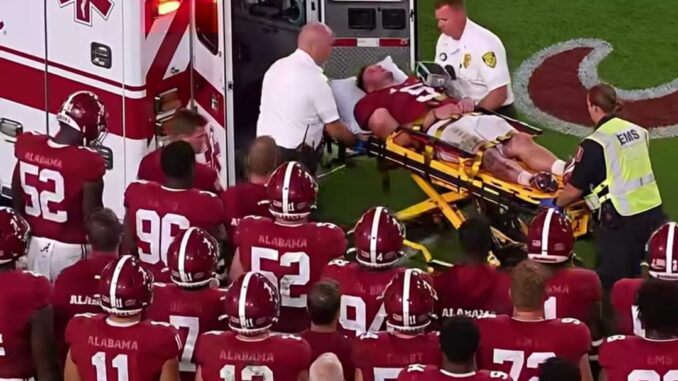
SCARIEST SCENE ON AN ALABAMA CRIMSON TIDE FOOTBALL FIELD? A Terrifying Injury During the Game Against the Tennessee Volunteers Raises Serious Concerns for an Alabama Star
KNOXVILLE, Tenn. — The scene was as frightening as anything you will see on a football field. A senior captain, one of Alabama’s most respected players, lay motionless on the Neyland Stadium turf. The crowd went silent. Coaches sprinted across the field. Trainers surrounded him. For several agonizing moments, no one knew if Bray Hubbard would get up.
He did. Slowly, shakily, but he did. But the image of Hubbard flat on his back—the victim of a vicious blindside block that had no place in the game—lingered long after he walked off under his own power. It was the scariest moment of a brutal afternoon in Knoxville, and it raised serious concerns about the safety of one of Alabama’s most important defensive players .
The Hit That Stopped the Game
The play occurred in the middle of the fourth quarter with Tennessee leading 19-10. Volunteers running back DeSean Bishop broke free for a 34-yard run. Hubbard, a senior defensive back and team captain, was pursuing the play when Tennessee receiver Mike Matthews delivered a block that officials immediately flagged for a personal foul and ruled a blindside hit .
The contact was violent. Hubbard went down instantly and did not move. He lay motionless on the Tennessee sideline for several moments—a terrifying pause that silenced the stadium and drew Alabama head coach Kalen DeBoer across the field to check on his captain .
Hubbard eventually rose to his feet. He did not return to the game. By the time he exited, he had recorded 10 tackles and broken up one pass—a stat line that underscored just how much Alabama’s defense had relied on him throughout the afternoon .
A Cascade of Injuries
Hubbard’s frightening exit was not an isolated incident. It was the most visible moment in a game that saw Alabama’s roster battered from start to finish.
Cornerback Zabien Brown, a potential first-round NFL draft pick, left the game in the second quarter with a lower-extremity injury and did not return. He was seen on the sideline in street clothes in the second half . Freshman running back EJ Crowell also exited in the second quarter with a lower-extremity injury, walking off the field late in the fourth quarter with a brace on his left knee .
DeBoer offered little clarity after the game. “Both of them, both Zabien and EJ, have lower-extremity injuries, and we will work through it here this week,” he said. “I don’t have much more than that” .
Those injuries came on top of an already depleted depth chart. Alabama played without its leading receiver, Ryan Coleman-Williams, who underwent arthroscopic knee surgery and is considered week-to-week with a head injury as well . Starting center Racin Delgatty was also out with a lower-leg injury . Defensive lineman Terrance Green, linebackers Cayden Jones and Desmond Umeozulu, and defensive back Nick Sherman were all unavailable .
The Context of Concern
What made Hubbard’s hit particularly alarming was the context. This was not a clean, legal tackle. It was a blindside block—the kind of play the NFL and college football have spent years trying to legislate out of the game because of the severe injury risk it poses to defenseless players.
Hubbard is a senior captain. He is the kind of player every program needs: a leader, a tackler, a tone-setter. He had already made 10 tackles in the game before the hit. The sight of him motionless on the turf was a visceral reminder of how quickly a season—and a career—can change on a single play.
The fact that he was able to walk off the field was a relief. But the long-term implications remain unclear. Alabama has not released a diagnosis or a timeline for his return. With a game against Texas A&M looming and a bye week offering a brief respite, the Crimson Tide will be holding its breath .
The Loss Beyond the Scoreboard
Alabama lost the game 26-10. That matters. It was the Crimson Tide’s second straight defeat and a significant blow to their SEC and playoff aspirations. The offense was stagnant, the quarterback play was uneven, and the Volunteers controlled the game from the second quarter onward .
But the injuries—and Hubbard’s hit in particular—felt bigger than a single loss. They raised questions about player safety, about the physical toll of a brutal SEC schedule, and about whether Alabama has the depth to survive a stretch that suddenly looks far more daunting than it did a week ago.
DeBoer, who walked across the field to check on Hubbard himself, understood the gravity of the moment. His captain was down. His roster was crumbling. His team was losing. And the scariest scene of the afternoon had nothing to do with the scoreboard.
Hubbard got up. That is the headline. But the image of him lying there—motionless, surrounded by trainers, the stadium holding its collective breath—is one that will not fade quickly. And the question of whether he will be the same player when he returns is one that Alabama fans will be asking for weeks to come.
Leave a Reply