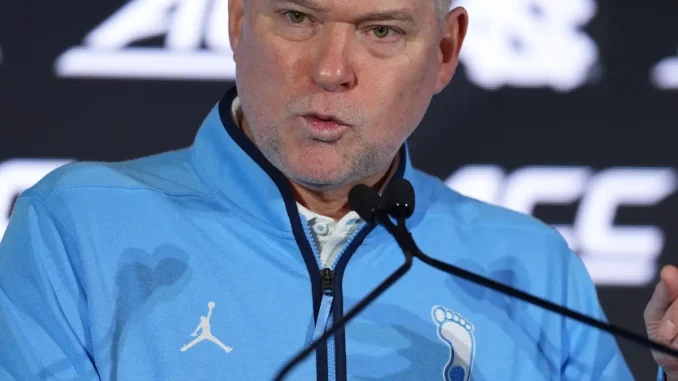
UNC basketball escapes exhibition scare, but bigger questions remain for Michael Malone
CHAPEL HILL, N.C. — Michael Malone walked off the Dean Smith Center floor with a win in his unofficial home debut, but the 89-82 overtime escape against Charlotte on Tuesday night felt less like a victory and more like a reprieve.
The Tar Heels trailed by 15 points in the first half, needed a technical foul on Charlotte for calling a timeout it didn’t have with 16.9 seconds left in regulation just to force overtime, and were outrebounded by a smaller, less talented opponent . The final score will go in the books as a win. The performance will go in the scouting report as a warning.
“You’re never satisfied,” Malone said afterward. “We all know collectively that we can and we have to play a lot better. The season is upon us. There’s no more exhibition games. We’re done. So we have to clean things up in a hurry” .
The question now is whether those things are fixable in a week, or whether they are structural flaws that will define Malone’s first season in Chapel Hill.
The Rebounding Problem Is Real, and Malone Knows It
The most glaring issue through three exhibition games has been North Carolina’s inability to secure the basketball. Against Charlotte, the Tar Heels were outrebounded 36-30, surrendered 12 offensive boards, and allowed 18 second-chance points . Over the full preseason slate, UNC posted a minus-14 rebounding differential and gave up 44 offensive rebounds .
The numbers from the starting frontcourt are alarming. Sayon Keita, a 6-foot-11 freshman, grabbed two rebounds in 33 minutes. Jarin Stevenson, a 6-foot-10 senior, had two rebounds in 38 minutes . Malone did not mince words.
“Sayon can’t have two rebounds in 33 minutes,” Malone said. “That can’t happen. But we need everybody else. Jarin had two rebounds in 38 minutes. That’s your 4 and 5 at four rebounds and a lot of minutes on the floor” .
Malone’s partial solution—or at least his partial explanation—is Cameron Fens, the 7-foot, 255-pound transfer from South Dakota who averaged 14.4 points and 8.7 rebounds last season. Fens is currently ineligible while seeking a fifth year of eligibility, and his status remains unresolved . Until then, Malone is left with a frontcourt that has been physically overmatched.
“Rebounding is not a skill,” Malone said. “It’s a want to. It’s a desire. It’s toughness. I can’t make our guys bigger and stronger. I just don’t have that power. I wish I did. This is our roster until Cameron Fens is eligible” .
Terrence Brown Looks Like the Answer—But Also the Only Answer
The one unequivocal positive from Tuesday night was Terrence Brown. The Utah transfer scored 27 points on 9-of-18 shooting, repeatedly got to the free-throw line, and hit the dagger three-pointer in overtime to seal the win . After a slow start to the preseason, Brown looked like the lead guard Malone needs.
“You saw a more aggressive Terrence,” Jaydon Young said. “That’s the Terrence we expect. That’s the Terrence we know” .
But Brown’s dominance also highlights a concerning dependency. The Tar Heels’ offense stalled for long stretches, particularly in a first half that Malone described as “the Keystone Cops”—a stretch in which UNC had more turnovers than made shots ten minutes in . When Brown wasn’t creating, nobody else consistently could.
Neo Avdalas, the 6-foot-9 transfer from Virginia Tech, offered a bright spot with 16 points, nine rebounds, and five assists, showcasing the versatility that made him a coveted portal addition . But the half-court offense remains a work in progress, with too much standing and watching when Brown isn’t probing the defense .
The Bigger Questions Malone Must Answer
Beyond the rebounding and the offensive cohesion, Malone faces structural questions that exhibition games alone cannot resolve.
First, is this roster built to compete in the ACC? North Carolina was picked to finish fifth in the conference in preseason polling, and CBS Sports ranked the Tar Heels 32nd nationally . The backcourt of Brown, Avdalas, and Matt Able—who did not dress against Charlotte for undisclosed reasons—is talented but unproven as a unit . The frontcourt is a genuine liability until Fens returns, if he returns.
Second, can Malone’s NBA system translate? Malone has spoken repeatedly about ball movement, player movement, and defense fueling offense. Through three exhibitions, the Tar Heels shot 43.1 percent from the field and looked disjointed for long stretches . The adjustment from NBA schemes to college personnel—and college officiating, and college spacing—is not instantaneous.
Third, what happens when the games count? The Tar Heels open against Western Carolina on Nov. 2, then face West Virginia, No. 12 Arkansas, and No. 23 Kentucky before ACC play begins . The exhibition schedule exposed weaknesses that better teams will exploit. Charlotte, a solid mid-major program under Wes Miller, came within a technical foul of beating UNC at home. Arkansas and Kentucky will not need that kind of help.
Malone, to his credit, is not hiding from any of this. He called out his frontcourt’s rebounding by name. He acknowledged his team’s first-half nerves. He described the win as something to learn from rather than celebrate.
“Nobody got hurt, while also fully understanding there’s much work to be done,” Malone said .
The work starts now. The grace period ends Monday.
Leave a Reply