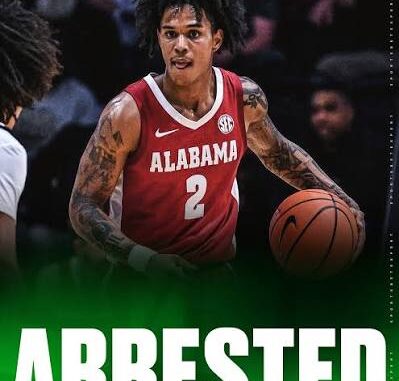
SHOCKING: Aden Holloway Breaks Silence on Arrest Ahead of Alabama Basketball Return
TUSCALOOSA, Ala. — He didn’t have to do it. Nobody forced him to sit behind that microphone. The school’s media relations staff didn’t schedule it. Coach Nate Oats didn’t demand it.
Aden Holloway asked to speak.
For the first time since his March arrest and the nine-month odyssey of suspension, legal proceedings, and quiet rehabilitation, Alabama’s senior guard stood before reporters on Thursday and chose ownership over silence .
“I want to thank God, my family, the University, Coach Oats, Greg Byrne, all the Alabama fans, all my teammates, just for making a second chance possible and all the encouragement they’ve given me over the past year,” Holloway said, his voice steady but heavy .
What followed was not a scripted apology. It was a confession of transformation.
The Night Everything Stopped
The date was March 16, 2026. Alabama basketball was days away from the NCAA Tournament, a No. 4 seed preparing for a run that would eventually reach the Sweet 16. Holloway, the Crimson Tide’s second-leading scorer at 16.8 points per game and a third-team All-SEC selection, was a cornerstone of that run .
Then agents with the West Alabama Narcotics Task Force searched his Tuscaloosa residence. They found 2.1 pounds of marijuana, cash, and drug paraphernalia . Holloway was arrested on felony charges: first-degree possession of marijuana, not for personal use, and failure to affix a tax stamp. He faced up to ten years in prison .
Alabama suspended him indefinitely. He was removed from campus. He watched the tournament from home as his teammates won two games without him .
The details that emerged in the following weeks were damning. A warrant revealed agents found marijuana in nearly every room of the residence—a vacuum-sealed bag in the living room, a bookbag in his bedroom, a box in the spare closet . Prosecutors alleged text messages on his phone showed evidence of drug transactions .
For a 21-year-old with a clean record and a promising future, the fall was swift and brutal.
The Second Chance
Holloway entered Tuscaloosa County’s Second Chance Program in June. The requirements were not symbolic: 50 hours of community service, random drug and alcohol screenings, educational classes, court-ordered payments, and a letter acknowledging responsibility .
He completed all of it.
On September 28, the remaining charge was dismissed. His criminal record was clean . But the university’s disciplinary process was separate. Alabama imposed a five-game suspension that covered three preseason exhibitions and the first two regular-season games .
He missed the season opener against Sam Houston. He missed Arkansas State. He watched from the bench, standing, coaching, cheering—present but powerless .
“It was frustrating, obviously,” Holloway said. “But I was just trying to stay as engaged as I could. I love watching these guys play. I like playing a little more, but watching them was fun, too” .
The Return
On Monday night, 241 days after his last competitive game, Holloway walked onto the floor at Coleman Coliseum. The crowd erupted when his name was announced in the starting lineup .
He finished with 12 points, all on three-pointers, in 21 minutes. Alabama beat Oakland 109-68 and tied a program record with 30 assists .
“It meant a lot,” Holloway said. “Just being able to suit up with my guys in the real game. We’ve been going at each other in practice for some months now, so just being able to get out there in the real game meant everything to me” .
Oats was measured but optimistic. He praised Holloway’s defensive intensity—something that had been a weakness in previous seasons—while noting that the guard still needs to improve on the glass .
“I thought it was definitely better than he was for most of the games last year,” Oats said .
The Weight of the Words
What made Thursday’s press conference remarkable was not the statistics or the game preview. It was the fact that Holloway chose to confront the elephant in the room before anyone could ask about it.
“I wouldn’t recommend my experience to anyone,” he said. “It’s been tough, but it definitely changed my life and reminded me of who and what was most important to me. I’m super thankful for that” .
Oats, seated beside him, was visibly moved.
“A lot of guys try to hide from it,” the coach said. “He’s actually owned what he’s done” .
That ownership, Holloway explained, extended beyond the courtroom and the suspension. It changed how he leads.
“What doesn’t kill you makes you stronger,” he said. “I feel like it’s just been a character development thing for me. Basketball-wise, I think I’ve been a little bit better of a vocal leader. Still working on it, but it’s definitely an area that I’ve grown in since last year” .
What Comes Next
Holloway’s return gives Alabama something it desperately lacked in its first two games: a proven perimeter scorer who shot 43.8% from three last season and earned All-SEC honors . The Crimson Tide’s offense sputtered without him, shooting just 35.3% from the field in first halves against Sam Houston and Arkansas State .
With Holloway back, the floor spacing changes. The ball moves faster. The ceiling rises.
But for Holloway, the basketball is almost secondary now. The microphone, the questions, the scrutiny—he asked for all of it. Not because he wanted sympathy. Because he wanted to close a chapter that had been hanging open for nine months.
“I want to thank everybody for making a second chance possible,” he said again, as if the words themselves were a debt he needed to repay .
The second chance has been earned. The return is complete. What Aden Holloway does with both is now the only story left to write.
Leave a Reply