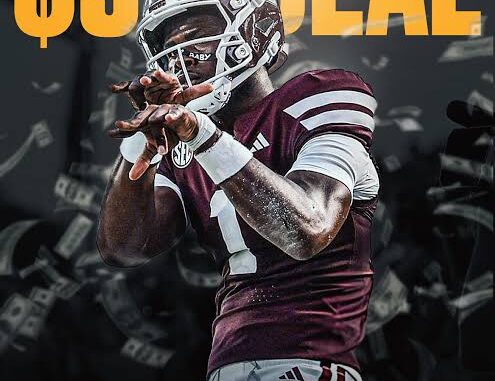
Breaking News: Mississippi State quarterback Kamario Taylor has agreed to a $7.5 million NIL deal to return for the 2027 season, with incentives that could push the total to $9 million. This figure not only makes him the highest-paid quarterback in college football history but also instantly resets the market for star quarterbacks nationwide. For Alabama, LSU, and Miami, the ripple effects of this deal are immediate and severe: all three programs now face enormous pressure to renegotiate contracts with their starting quarterbacks or risk losing them in the transfer portal.
Alabama: Keelon Russell’s “Raise” Is Inevitable
Alabama’s starting quarterback Keelon Russell is in the same class as Taylor, and his performance this season is arguably even more impressive. Through Week 11, Russell has led the Crimson Tide to a 7-2 record and the No. 3 national ranking, throwing for 2,263 yards (third in the SEC) with 18 touchdowns (tied for second in the SEC), while adding 276 rushing yards and 5 touchdowns on the ground.
However, according to On3, Russell’s current NIL income is only approximately $2 million. Taylor’s deal sets a clear benchmark: a quarterback with only 8 career starts and an injury-shortened season can earn $7.5 million, while Russell, who is healthier, more productive, and leading his team to the playoffs, has every reason to demand a substantial raise. Industry analysts generally expect that while Russell may not ask for $7.5 million, Alabama will likely need to significantly increase his compensation to ensure he stays in Tuscaloosa for 2027. Given Alabama’s playoff prospects and Russell’s rising draft stock, the Crimson Tide have almost no room to bargain.
LSU: The Sam Leavitt Dilemma
LSU’s situation is equally delicate. Head coach Brian Kelly prioritized landing transfer quarterback Sam Leavitt last year, paying an NIL package of approximately $4 million to $4.5 million. Leavitt’s performance has been respectable, but with Kelly entering his first full offseason, LSU’s goal is clear: compete for a championship in 2027.
The problem is that Taylor’s $7.5 million has completely recalibrated what $4 million buys. If LSU wants to retain Leavitt and convince him to forgo the portal, a price increase is almost certain. More critically, LSU is not among the SEC’s top spenders (Texas, Texas A&M, and Georgia are all bigger players), and the program must weigh whether to concentrate resources on one quarterback or spread them across a roster that still has holes. Either way, Taylor’s deal has made LSU’s negotiation with Leavitt considerably more expensive.
Miami: Malachi Toney and the Broader Payroll Problem
Miami is already the program with the highest single-season NIL expenditure in college football, having paid quarterback Darian Mensah approximately $6.5 million in 2026 (including buyout costs, with industry estimates exceeding $8 million). But the Hurricanes’ current headache is star player Malachi Toney, whose 2026 NIL income is only $2 million.
With Taylor securing $7.5 million and Ohio State’s Jeremiah Smith earning $5 million, Toney’s camp has ample reason to demand a raise. According to sources, Miami’s top priority this offseason is locking up Toney, but with Mensah’s massive contract already on the books, the Hurricanes’ NIL budget is nearing its ceiling. If Miami cannot satisfy Toney, the transfer portal will be full of programs willing to pay top dollar for a player of his caliber. Taylor’s deal has, in effect, provided Toney’s agent with the perfect negotiation ammunition.
The Bigger Picture: The Market Has No Ceiling
The real significance of Taylor’s deal lies not in Mississippi State but in the signal it sends: the quarterback market has no ceiling. A player with 8 starts and an injury history can command $7.5 million, which means any program with a competent starting quarterback must prepare for the possibility of a price doubling in 2027.
For Alabama, LSU, and Miami, the question is no longer “should we pay more” but “how much more can we afford to pay.” Mississippi State chose to overpay to prevent Taylor from entering the portal; the other three programs have no choice but to do the same. The college football arms race has officially entered a new phase where retention costs are approaching—or even surpassing—NFL rookie contract levels.
Leave a Reply