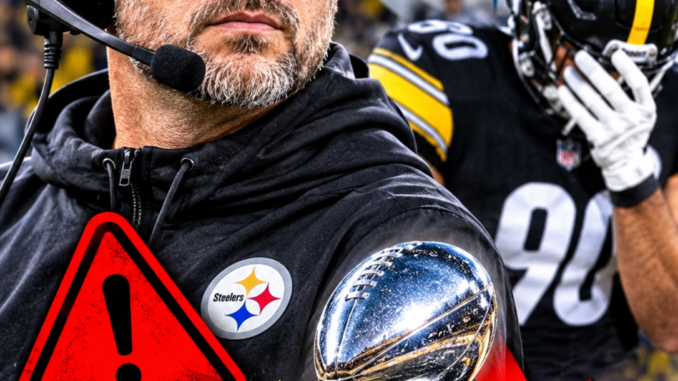
Pittsburgh’s Super Bowl Dreams Are Suddenly in DANGER as Crushing Weaknesses and Painful Questions Emerge
PITTSBURGH — The optimism that once surrounded the Steelers’ 2026 season has curdled into something far more familiar in Pittsburgh: quiet desperation disguised as business as usual.
On the surface, a 6-3 record and a brief stint atop the AFC North would suggest Mike McCarthy’s first year has gone according to plan. But the facade cracked wide open in a nationally televised humiliation against Cincinnati, and the structural flaws beneath the surface are no longer minor concerns. They are existential threats to a franchise that hasn’t won a playoff game since January 2017.
The Super Bowl odds tell the story of a dream rapidly fading. Pittsburgh opened the season at +5000 to hoist the Lombardi Trophy. By late October, those odds had ballooned to +12000—the second-largest negative shift in the entire NFL—translating to a mere 0.8% chance of championship glory . Even a recent bump back to +4000 reflects a market correcting an overreaction, not a genuine belief that this team is a contender .
The reasons are not mysterious. They are written in the film, in the numbers, and in the pained admissions of the head coach himself.
The Passing Game Is Broken at Its Core
McCarthy was hired specifically to modernize an offense that had grown stale under Mike Tomlin. The early returns are damning. Through the first quarter of the season, Pittsburgh ranked 25th in scoring at 17.5 points per game, with the fifth-lowest third-down conversion rate and a staggering 34% three-and-out rate .
The root cause is an inability to beat man coverage. Opponents have attacked the Steelers with man coverage at the highest rate in the league—40.2% of dropbacks—and Pittsburgh has responded with the 27th-ranked EPA per dropback against it. When teams add pressure behind that man coverage, the number plummets to 30th . Aaron Rodgers, at 42, completed just 48% of his passes against man coverage in a disastrous Cleveland outing that featured four sacks and an interception .
Rodgers’ individual metrics paint a brutal picture. He ranks 27th in success rate, 28th in EPA per dropback, and 28th in yards per attempt. His completion rate on passes traveling 10+ air yards sits at 34%—dead last among starting quarterbacks . The quick release that defined his 2025 season has slowed from 2.52 seconds to 2.76, and the results have been catastrophic behind a young, reshuffled offensive line that has surrendered the second-most sacks in the league .
The Offensive Line Is a Work in Progress That Cannot Afford to Be
Troy Fautanu flipped to the left side. Rookie Max Iheanachor debuted at right tackle. Mason McCormick, now lost for the regular season with a gruesome leg injury, was part of a unit that analysts warned could “go down a tier” before the season even began . The communication issues against stunts and games have been glaring. Rodgers has taken a league-worst seven sacks against man coverage, often because receivers cannot separate quickly enough to justify a throw .
This was always the risk. The Steelers invested heavily in youth and versatility up front, betting that coaching and talent would coalesce quickly enough to support a 42-year-old quarterback on a final ride. That bet is losing.
The Receiver Room Has Collapsed
The offseason plan was elegant in theory: DK Metcalf as the alpha, Michael Pittman Jr. as the reliable possession complement, and Roman Wilson as the developing vertical threat. In practice, it has been a disaster.
Metcalf has been one of the league’s most disappointing players, catching just 50% of his targets with the second-most drops in the NFL . Pittman, acquired via trade and signed to a three-year deal, has appeared in just three games, logging seven catches for 89 yards while battling plantar fasciitis that “morphed into something else” . Wilson, who showed flashes with 14 catches for 188 yards and two scores, dislocated one finger and broke another .
The return of Pittman and Wilson to practice this week offers a glimmer of hope. But both remain on injured reserve, and Pittman has been candid about his uncertainty. “I don’t want to go out there and hurt this team because I can’t do something that I should be able to,” he said . That is not the language of a savior riding in to rescue a broken passing game.
The Scheme Itself Is Under Fire
Perhaps most damning is the growing suspicion that McCarthy’s offense is not fixing the problem—it may be exacerbating it. The Steelers rank 31st in motion rate and 29th in motion usage at the snap, failing to manufacture free releases or leverage advantages for receivers who desperately need them . They sit 31st in play-action rate despite ranking first in rushing EPA per play, wasting the credibility of a genuinely effective run game .
McCarthy acknowledged the team’s inability to attack the middle of the field—a flaw that has plagued the franchise for years—but admitted that “the stats and video right now don’t support” the principle he claims to believe in . Meanwhile, ESPN analysts have accused Rodgers of “stat hunting” in the red zone, checking out of run plays at the goal line to chase touchdown passes on the all-time list. Pittsburgh’s pass rate inside the 10-yard line sits at 71%, a figure matched only by Rodgers’ recent Jets teams .
The Defense Can Only Hold the Line for So Long
The one stabilizing force has been a defense ranked sixth in scoring, allowing 19.1 points per game . But that unit is aging in the secondary and along the defensive line, and it is being asked to compensate for an offense that cannot sustain drives. Against Cincinnati, the dam broke. The Bengals had little trouble locking up Metcalf and Germie Bernard, and Rodgers threw for just 143 yards with two garbage-time touchdowns .
The Painful Questions
The questions now facing this team are not new, but they are sharper than ever.
Can a 42-year-old quarterback with declining mobility and a diminished supporting cast elevate a broken offense? The evidence through nine games says no.
Was hiring McCarthy—whose last head coaching stint ended in Green Bay with the same questions about stale schematics—the right move to maximize a closing championship window? The motion rates and play-action numbers suggest the offense is running a 2015 playbook in a 2026 league.
And perhaps most urgently: if this season ends in another Wild Card exit—or worse, a late-season collapse—what does that mean for a franchise that has now gone nearly a decade without a playoff victory?
Mike Tomlin’s departure was supposed to signal a new era. Instead, the Steelers appear trapped in the same purgatory: good enough to compete, flawed enough to fall short, and increasingly unlikely to reach the Super Bowl stage they once treated as a birthright.
The dream is not dead. At 6-3, Pittsburgh remains in playoff position. But dreams built on a 42-year-old arm, a patchwork offensive line, and a receiving corps held together by hope are fragile things. The next eight weeks will determine whether this season becomes a resurrection or merely another chapter in a drought that grows more painful with every passing year.
Leave a Reply