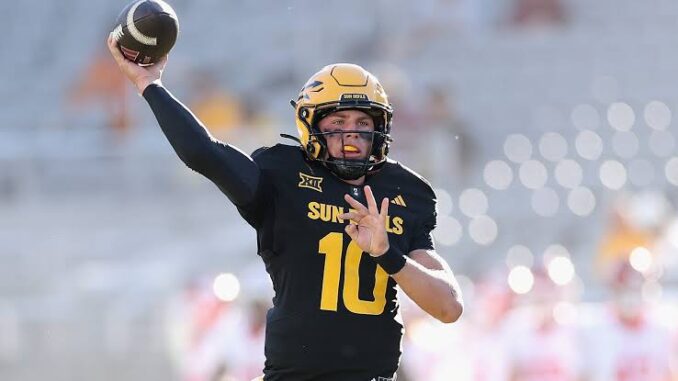
Sam Leavitt made his presence felt during LSU’s first spring practice of 2026, although the Tigers were careful with him as he continued recovering from a serious foot injury. The Arizona State transfer was one of the most closely watched players at LSU’s opening workout under new head coach Lane Kiffin, and his participation offered an encouraging early sign for the Tigers’ new-look offense.
Leavitt did not participate in full-team work during the opening practice. Instead, he was limited primarily to individual drills. He was seen throwing the football and moving around the practice field, giving LSU coaches their first opportunity to watch him work physically within the new offensive system. Kiffin explained afterward that Leavitt was moving around but was not yet ready for team periods.
That limitation was understandable because Leavitt was coming off a Lisfranc injury that had ended his 2025 season at Arizona State after only seven games. The injury required surgery, making his recovery one of the biggest storylines surrounding LSU as spring football began.
Still, the fact that Leavitt was able to throw and move his lower body during the first practice was significant. Kiffin indicated that this was essentially Leavitt’s first meaningful opportunity to throw and move after the injury. The expectation was that his workload would increase as spring progressed.
Another important aspect of Leavitt’s first practice was his involvement with the first-team group during individual work. Although he couldn’t yet compete in team situations, his presence allowed him to begin learning Kiffin and offensive coordinator Charlie Weis Jr.’s system firsthand.
For LSU, that was particularly valuable because the quarterback position is expected to be central to Kiffin’s offensive philosophy. Kiffin has described quarterbacks as essentially the point guards of his system: they must understand what is happening and distribute the football correctly for the offense to operate efficiently.
While Leavitt was limited, LSU used other quarterbacks for the majority of team repetitions. Husan Longstreet and Landen Clark handled significant first-team work during portions of the spring while Leavitt concentrated on his rehabilitation and learning the offense.
Leavitt’s progress continued throughout spring. By March 31, he was participating in virtually every drill except the quarterback-run period, including work involving read-option mesh points. That represented another step forward in his recovery.
By the final spring practice, Leavitt was even able to participate in some 7-on-7 work, giving LSU an encouraging glimpse of its projected starting quarterback operating with receivers in a competitive setting.
Overall, Leavitt’s first spring practice was less about spectacular statistics and more about getting back on the field, throwing the football, learning the offense and gradually rebuilding his mobility. For LSU, seeing its highly anticipated transfer quarterback participate at all was an encouraging beginning.
The biggest takeaway was simple: Leavitt wasn’t fully cleared for football yet, but his recovery was moving in the right direction. His gradual return throughout spring gave LSU fans reason to believe that, if healthy, he could be ready to lead Kiffin’s offense when the 2026 season arrived.
Leave a Reply